A note from Teo
How to use ChatGPT or Claude to read a medical study, and catch it when it’s wrong
AI assistants summarise the abstract and call it the paper. How to make one quote the paper, and a two-minute check that catches its mistakes.
My grandson showed me how to paste a research paper into one of these AI chat assistants, and I have been checking their homework ever since. Here is what they get wrong when they read research. They summarise the abstract and call it the paper. They round numbers. They answer confidently about tables they never read. When there's a gap, they fill it with something that sounds right, because sounding right is the thing they're best at.
None of that is lying. It's worse. It's fluent.
A chat assistant can still be a good reading partner. You just have to make it slow down, and then check it.
Before you start
- Get the whole paper, not the abstract. Many are free on PubMed Central. An AI given only the abstract will answer from the abstract, and it won't always say so.
- Paste the paper, never yourself. Don't paste your own health records, results or letters, or anything with your name or date of birth on it. What you type into a chat assistant may be stored, and some services use it to improve their models unless you switch that off. Papers are public. You are not.
Ask one thing at a time
"Summarise this paper" invites the abstract back in different words. Ask narrow questions instead, in this order:
- What kind of study is this? Were people assigned, or watched?
- Who was studied, and how many were screened, randomised and analysed?
- Compared to what?
- What are the numbers for the main outcome in each group, over what time?
- Who paid, and what limits do the authors admit?
Only after the numbers, ask for a plain summary. A summary written after the numbers is harder to bend.
Make it show its receipts
Add rules to every question:
- Quote the paper for every claim, and say where the quote is (section, table or figure).
- Copy numbers exactly. No rounding.
- If something isn't in the paper, say "not in the paper". Don't guess.
- Keep your own opinion separate, under its own heading.
- Don't give medical advice.
These don't make an AI accurate. They make its mistakes easy to find.
A worked example
The BMJ published a randomised trial of parachutes in 2018. Its abstract reports that parachutes made no difference to death or major injury. Two sentences later comes the catch: the people who agreed to jump were on a biplane or a helicopter parked on the ground, jumping about 0.6 metres. The 69 people screened but not enrolled were all on jetliners, in the sky. The result, 0% in both groups, is real. It tells you nothing about jumping from a plane in flight, because nobody in the trial did. That's the joke, and the lesson: it only works on readers who stop at the abstract.
In my guide I wrote an example AI answer with a typical mistake in it: "92 adults were randomised." Here's the check:
- Find the sentence. Search the paper for "92". The abstract says 92 were screened, and 23 agreed to be enrolled and were randomised.
- Match the number. The number is real. The word attached to it is wrong. Screened is not randomised.
That took under a minute, and it's the kind of mistake that changes what a study means.
The two-minute check
Every time, check one answer against the paper:
- Find the sentence. Search for four or five words of the quote. If you can't find it, it isn't a quote.
- Match the number. Same number, same group, same time point, same word attached to it.
- Spot-check a table. Tables are where the numbers live and where pasted text goes wrong.
- Test a "not in the paper". Search once yourself. Sometimes it's in a table the AI couldn't read.
What an AI can't do for you
It can't tell you what a paper means for your body. Neither can I. A paper is about the people in it. Take that question to someone who can examine you.
The receipts
- Yeh et al., BMJ, 2018: the parachute trial, free on PubMed Central.
The prompts, ready to paste
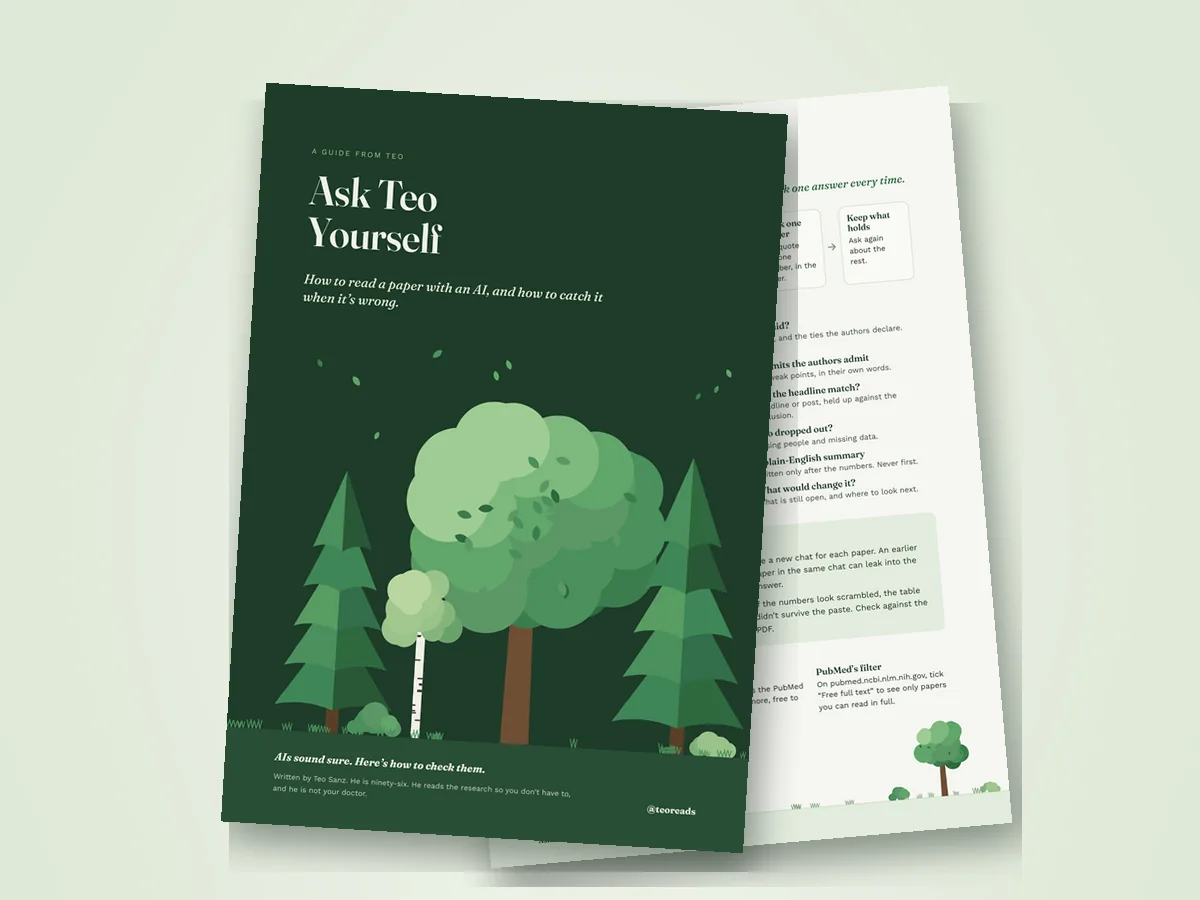
Ask Teo Yourself has twelve prompts built on these rules, one question each, and a ten-page guide that walks the parachute trial from prompt to check. If you'd rather read without an AI, here's the order I read a paper in.
This is education about reading research, not medical advice. Take your questions to someone who can examine you.