A note from Teo
“Linked to” is not “causes”: correlation and causation in health news
Why people who do one thing differ in other ways, how that fooled a generation of doctors, and the one question that separates a link from a cause.
"Coffee drinkers live longer." "Night owls at higher risk." "Dog owners have healthier hearts." Each of these headlines rests on the same kind of study, and each uses a word that does a lot of quiet work: linked.
What "linked to" means
It means researchers watched people, sorted them by what they did, and counted what happened to them. People who did the thing had more (or less) of the outcome. That's a link, also called an association or a correlation.
What it doesn't mean is that the thing caused the difference. The people weren't assigned to drink coffee or own a dog. They chose to. And people who choose one thing tend to differ in other ways too.
Why the people are the problem
Say coffee drinkers live longer. Coffee drinkers may also be healthier to begin with, because people who feel unwell often cut down. They may be wealthier, or work different hours. Researchers try to adjust for these differences, and good ones adjust for a lot. But they can only adjust for what they measured. The name for the rest is confounding: a third thing, tangled up with the first, that's doing some or all of the work.
The case that fooled a generation
For years, large observational studies, the Nurses' Health Study among them, found that women taking hormone therapy after menopause had noticeably fewer heart attacks than women who didn't. It looked like protection, and many doctors recommended hormones partly on the strength of it.
Then the Women's Health Initiative ran a randomised trial. It assigned 16,608 women to hormones or a placebo, so that choice played no part. The trial was stopped early, after an average of 5.2 years. The hormone group had slightly more coronary events, about 37 against 30 for every 10,000 women each year, and more breast cancer, 38 against 30.
Later analyses suggested part of the gap came from who takes hormones and when they start. The women who chose hormones had differed in other ways. The link had been real. The cause had been assumed.
This isn't a note about whether anyone should take hormone therapy. That's a conversation between a patient and a clinician, and the picture has been refined a great deal since 2002. It's a note about how much weight "linked to" can carry.
The one question
Were people assigned, or did they choose?
- If researchers assigned who got what, ideally at random, it's a trial. Differences in outcome are much more likely to come from the thing itself.
- If people chose, it's observational. The study can show a link, suggest a cause worth testing, and sometimes it's the only evidence we'll ever get. But treat the cause as a question, not an answer.
Words that tell you which you're reading
- Observational: linked, associated, cohort, case-control, people who... were more likely to.
- Trial: randomised, randomized controlled trial, placebo, assigned.
The methods section says which. It's usually the first paragraph after the introduction.
When a link is more convincing
Some links earn more trust: a big effect, a dose that matters (more of the thing, more of the outcome), the same result in different populations and study designs, and a plausible mechanism. The link between smoking and lung cancer had all of these, and nobody could ever ethically run a trial to test it. So a link isn't nothing. It's a lead that has to keep earning its keep.
The receipts
- Grodstein et al., Annals of Internal Medicine, 2000 (Nurses' Health Study).
- Writing Group for the Women's Health Initiative Investigators, JAMA, 2002.
Keep the question handy
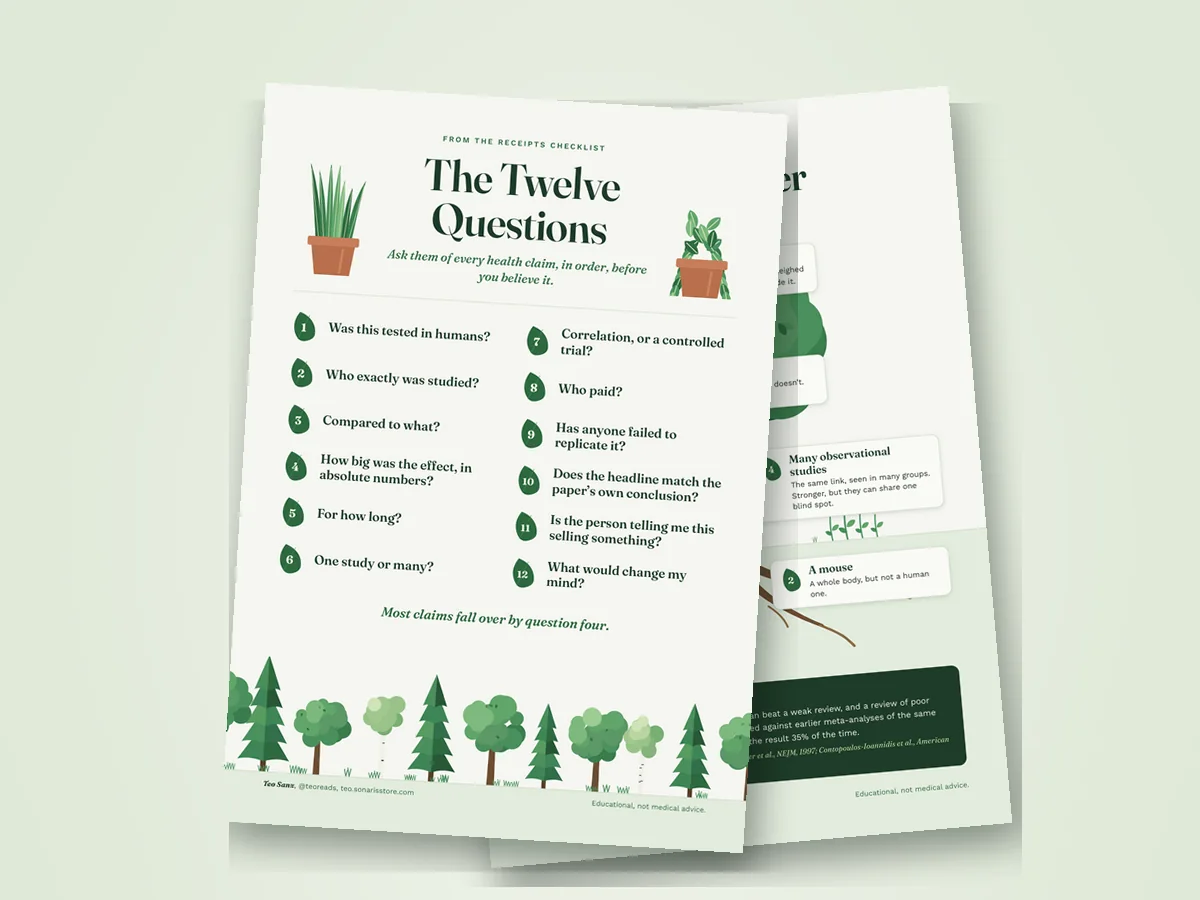
"Correlation, or a controlled trial?" is question seven in The Receipts Checklist, with a real case and the phrase that gives it away. The Evidence Posters put the whole evidence ladder on your wall.
This is education about reading research, not medical advice. Take your questions to someone who can examine you.