A note from Teo
How to read a health research paper: start at the back
Skip the abstract. Read the methods, then the results table, then the conclusion. A reading order for health papers that anyone can learn in an afternoon.
Most people read a research paper the way it's printed: title, abstract, introduction, and then they run out of patience somewhere in the methods. I read it nearly backwards. The abstract is the paper's own press release. The methods and the results table are where it keeps its receipts.
You don't need a science degree for this. You need a table, a pen, and about twenty minutes.
Where to find the paper
- PubMed is a free search engine for medical research, run by the US National Library of Medicine. Search the author's name and a few words of the headline.
- Many papers are free to read in full. Look for "free full text" or a link to PubMed Central.
- A DOI (a code like 10.xxxx/...) is the paper's permanent address. News articles often link it at the bottom.
- A preprint (from servers such as medRxiv) hasn't been through peer review yet. That doesn't make it wrong. It does make it early.
1. The question, in one line
Read the title and the last paragraph of the introduction, where the authors say what they set out to test. Write it down in your own words. "Does X change Y in people like Z?"
2. The methods, before anything else
This is where most claims live or die. Find:
- Who was studied. People, animals or cells? How many? Age, sex, health, country.
- Assigned or observed. A randomised trial assigns who gets what. An observational study watches people choose. It changes everything about what the result can mean. (I wrote a note on why "linked to" isn't "causes".)
- Compared to what. A placebo, the usual treatment, or nothing at all.
- For how long. Weeks or years.
- The main outcome. The one thing the study was designed to measure. Everything else is a secondary outcome, and deserves less weight.
3. The results table
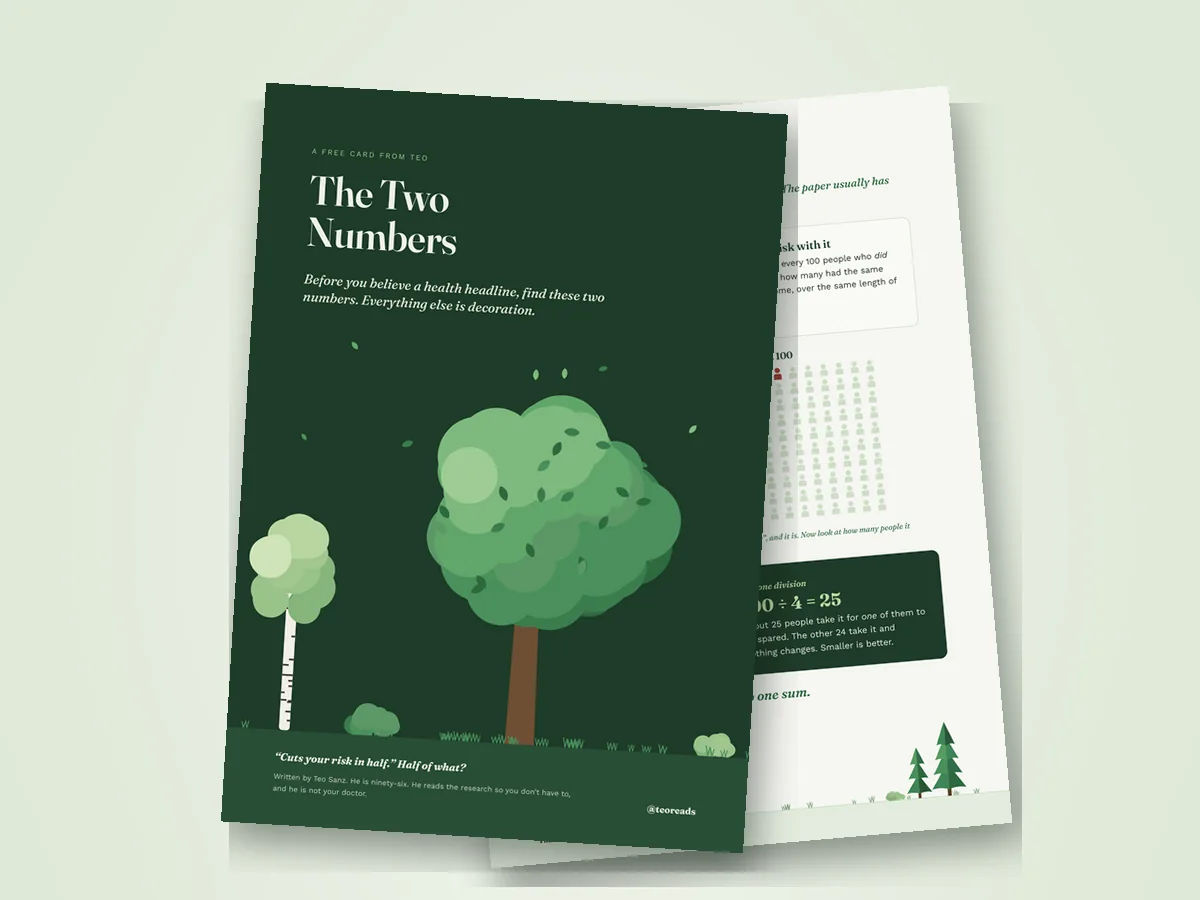
Skip the paragraphs and go to the main table. For each group, find the number of people and the number who had the main outcome. Those are the two numbers: the risk without it and the risk with it. Subtract. That's the size of the effect.
Two more things in the table:
- Confidence intervals. The range the true effect probably sits in. For a ratio, 1 means no difference; if the interval includes 1, the paper can't rule out no effect. For a difference, the same goes for 0.
- P-values. "p < 0.05" is a convention, not a verdict. It says nothing about how big the effect is.
4. The admissions
Near the end, the authors list the study's limitations. Read them. They know the weak spots better than anyone. Then find the funding and the conflicts of interest, usually in small print after the conclusion.
5. Only now, the abstract and the conclusion
Compare them with what you found. Does the conclusion claim more than the main outcome showed? Does the abstract lead with a secondary outcome? Does it give only the relative number? Then compare the paper's own conclusion with the headline that sent you here. The paper is usually the more careful of the two.
A short list to keep beside you
- What was the question?
- Who, how many, for how long?
- Assigned or observed? Compared to what?
- The two numbers for the main outcome.
- What do the authors admit? Who paid?
- Does the headline match the conclusion?
If you read with an AI
An AI can help, and it will also summarise the abstract and call it the paper. If you use one, make it quote the methods and the table, and check its numbers against the paper. That's what Ask Teo Yourself is for: twelve prompts and a guide to checking the answers.
The questions I ask of every claim, with a real case for each, are in The Receipts Checklist.
This is education about reading research, not medical advice. Take your questions to someone who can examine you.