A note from Teo
Mice are not small people: what “tested in the lab” really means
A result in a dish or a mouse is where research starts, not where it ends. How to tell how far a health claim has actually travelled.
"Shown in laboratory tests." A laboratory is a building. The question is who was in it: some cells, some mice, or some people.
The ladder a claim climbs
Health research tends to climb the same ladder, and a claim is only as strong as the rung it has reached:
- Cells in a dish. Something happens to cells in a controlled setting. Useful for ideas. A dish is not a body.
- Animals. Usually mice or rats, often bred for the purpose. Useful, and still not you.
- A few people, watched. Case reports and small observational studies. The first sign it might happen in humans.
- Many people, watched. Large observational studies that follow people for years. Good at finding links, weak at proving causes.
- People, assigned. Randomised controlled trials, where researchers decide who gets what. The best way to test whether a thing causes an effect.
- All the trials, together. Systematic reviews that gather every good trial on a question. The top rung, when the trials beneath it are good.
It's a rough guide, not a law. One large, well-run trial can be worth more than a review of small, weak ones. But a claim that's still on rung one or two is a promising idea, not a finding about people.
A famous example
In 2006, a paper in Nature reported that resveratrol, a compound found in grape skins, helped mice live longer and healthier. The mice were middle-aged males on a very high-fat diet. The headlines said red wine. The dose, scaled up to a person, worked out at cases of wine a day, not a glass. And a mouse is not a small person. Mice live about two years, eat things we don't, and are often bred to get the very disease being studied.
That paper was good science about mice. The trouble started in the retelling.
Words that tell you which rung you're on
- In vitro, cell culture, cell line: rung one.
- In mice, in rats, animal model, preclinical: rung two.
- Associated with, linked to, cohort, observational: rungs three and four.
- Randomised, placebo-controlled, trial: rung five.
- Systematic review, meta-analysis: rung six.
If the article doesn't say, look at the paper's methods. The first paragraph usually tells you who or what was studied.
Why early rungs still matter
None of this makes lab work useless. Most treatments that now help people started in a dish or a mouse. The point is timing. A result on rung two is a reason for more research, not a reason to change what you do. When someone sells you a rung-two result as a rung-six fact, that's a red flag.
The receipts
- Baur et al., Nature, 2006.
Keep the ladder where you can see it
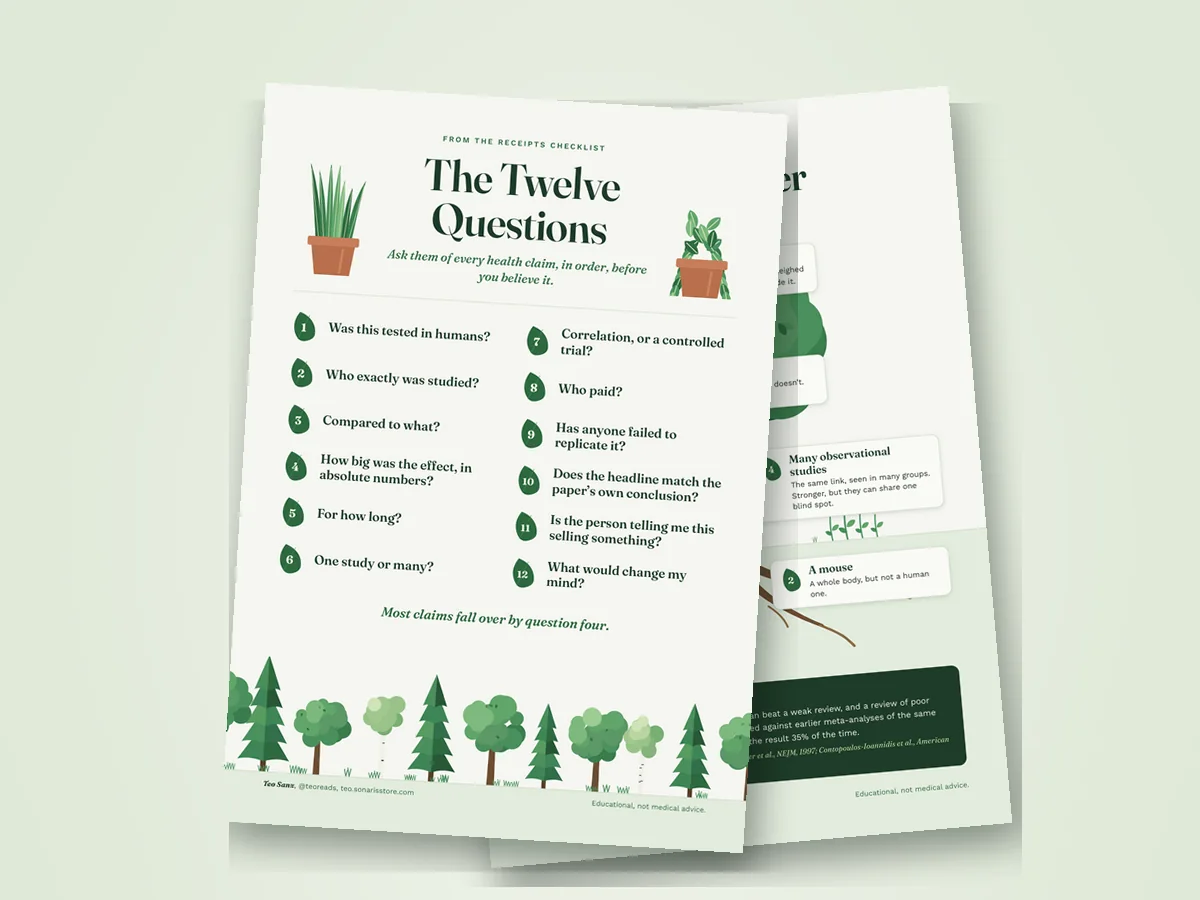
The Evidence Posters include the ladder as a print for your wall, next to the twelve questions and the two numbers. The full method, with a real case for each question, is The Receipts Checklist.
This is education about reading research, not medical advice. Take your questions to someone who can examine you.